Gus, and the Case for Imperfect Companions
Gus arrived without ceremony.
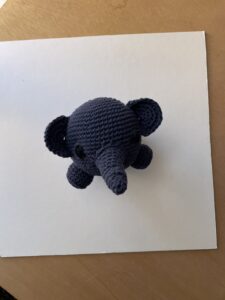
No trumpet fanfare. No inspection clipboard. Just a small, slightly lopsided elephant placed gently on the table, as if he’d wandered in from another room and decided to stay.
If you look closely — and I always do — you’ll notice a few things.
His trunk doesn’t quite attach the way the diagram promised. The stitches hesitate there, as though the yarn needed a moment to think about it and then went on anyway. One ear has a hole you can see clear through, a little window where the stuffing peeks out, curious about the world. His eyes are embroidered with the earnestness of a first attempt: not wrong, exactly, but still learning how to look back.
In short, Gus is not perfect.
Which is to say, Gus is perfect.
I’ve met many flawless things in my time. They tend to remain on shelves, admired from a distance, waiting for conditions to be just right. They are fragile in a way no one admits — one mistake away from no longer being allowed to exist.
Gus is different.
Gus was made by hands that were paying attention. Hands that were learning. Hands that did not stop when the instructions grew vague or when the yarn refused to behave. Hands that chose continuation over correction.
He carries evidence of that choice in every stitch.
When I hold him, I don’t think about what could have been tightened or redone. I think about evenings spent trying, about courage disguised as curiosity, about the quiet decision to finish something even when it didn’t turn out exactly as planned.
There is a kind of love that only imperfect things receive.
Perfect objects ask to be preserved. Imperfect ones ask to be held.
Gus doesn’t mind if you notice his flaws. He doesn’t apologize for them. He seems, in fact, quite pleased with himself — as though he knows something we are always in danger of forgetting:
That the point of making is not mastery.
It is companionship.
So Gus sits here now, watching the room with his slightly uneven gaze, entirely unconcerned with improvement. He is already finished. He is already enough.
And if that isn’t a lesson worth stitching into memory, I don’t know what is.